My colleague and I were sitting in a Zoom waiting room, and the philanthropist we were about to ask for an eight-figure gift was late. Should we email him? Reschedule? Just wait? I've made big asks before, but I was nervous about this one.
By the time he joined, we had 20 minutes left to share the vision, make the ask, and hear what he thought. What made those 20 minutes possible? I'll come back to that. |
|
|---|
|
A clock measured in years |
I hear this all the time: "Our ceiling seems to be six-figure gifts. How do we get past it?"
Looking back on the more than 80 six-, seven-, and eight-figure gifts I've helped close, many of the largest took three to five years, sometimes longer. Yet most of us work inside an annual budget cycle, with goals that start over every 12 months.
If one gift might close this year and one relationship might lead to something much larger in three years, I know which gets your attention as year-end approaches. It has to, because the annual goal matters. But a revenue report won't show whether that longer relationship is growing. |
|
|---|
|
Visits and calls can't show that either, so here's what I watch for:
Width. Does the donor know several people at your organization, staff and board, including someone on the senior team? At this size, donors are trusting the whole team, and that trust shouldn't rest on one relationship.
Depth. Do we know, in the donor's own words, what they hope their giving will change, and where our work fits among their priorities? Depth can also tell you when to stop. I once spent six months with a donor who could have made an eight-figure gift, and I got my hopes up. From the start, she told us she wanted to give directly to one young person, which our model didn't allow. We heard her answer early. Hope kept us from believing it.
Vision. Has the donor seen the future you're working toward? It's not about promising to double your numbers, but about letting them see what you believe is possible. One leader I worked with changed a campaign with one sentence: "Five years from now, I hope the pantry isn't the core of our services." The building went from a loan to pay off to a permanent hub where people could move from crisis toward opportunity. The ask could grow because the meaning grew.
Motion. Is the donor getting chances to decide things along the way, like exploring a bigger idea, introducing someone, or even telling you this isn't a priority? Years of cultivation are normal at this level. What isn't fine is deciding what a donor will say without giving them the chance to say it.
Every gift this size has its own story, and not every relationship will show all four signs. In a crisis, someone may decide quickly because years of trust are already in place. |
|
|---|
|
Who protects the long game? |
Whether long-term donor work gets time and credit is a leadership decision, and I know how hard that is when the budget has a hole in it. Still, the CEO and development leader need to make room for it.
They also need a plan for turnover. People move on, and nobody should feel guilty about it, but the donor shouldn't have to start over. My answer is AMRAP, borrowed from the gym: As Many Relationships As Possible, and meaningful ones, guided by the donor's interests. What we learn belongs in the CRM, where the next person can find more than a list of meetings.
When a board member is the only person who knows a donor well, I understand the protective instinct. At smaller and even midsize organizations, I've seen board members keep these relationships warm when no staff member could. Even so, the most generous thing they can do is bring others in: invite the CEO to lunch, or introduce the program leader whose work the donor cares about. |
|
|---|
|
Choose one of your top prospects and walk through the four signs with your team, using the worksheet.
If you lead the organization, ask your development lead: which of our top donors would we lose touch with if one person left? |
The decade behind the 20 minutes |
So, back to that call. He said yes to everything we asked for. We'd walked in nervous but confident, because we knew what had come before us.
He had spent a decade deciding what he thought of the organization. When I stepped in, years of notes were waiting in the CRM. Colleagues who had watched the relationship grow were still there, and former board members from the beginning had stayed involved. He knew so many of us that there was never a formal handoff. And somewhere along the way, he had started saying "we" when he talked about the vision. That's one of the most wonderful things in this work.
People came and went, but the organization never lost touch with him.
The meeting took 20 minutes. The capability behind it took a decade.
|
Which of your top donor relationships are growing, and which are just staying busy? |
|
|---|
|
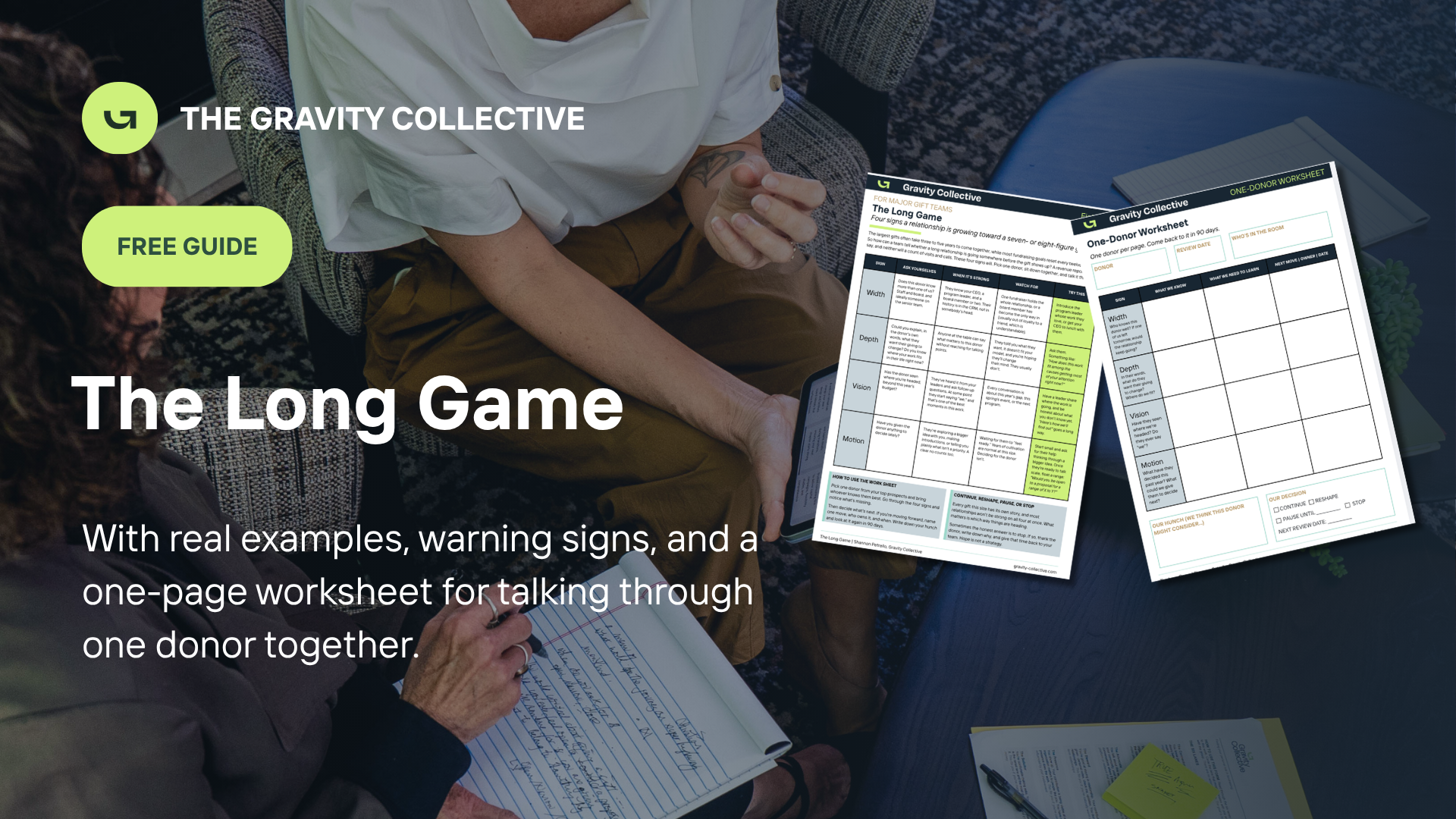
I made The Long Game to help your team talk that through. It's a two-page guide to the four signs I watch for, with a worksheet you can use for each donor.
Subscribe to my monthly newsletter and I'll send it to you, along with future stories and tools. Unsubscribe anytime. |
|
|---|
|
|
|